UX Research

LG CNS

LG CNS

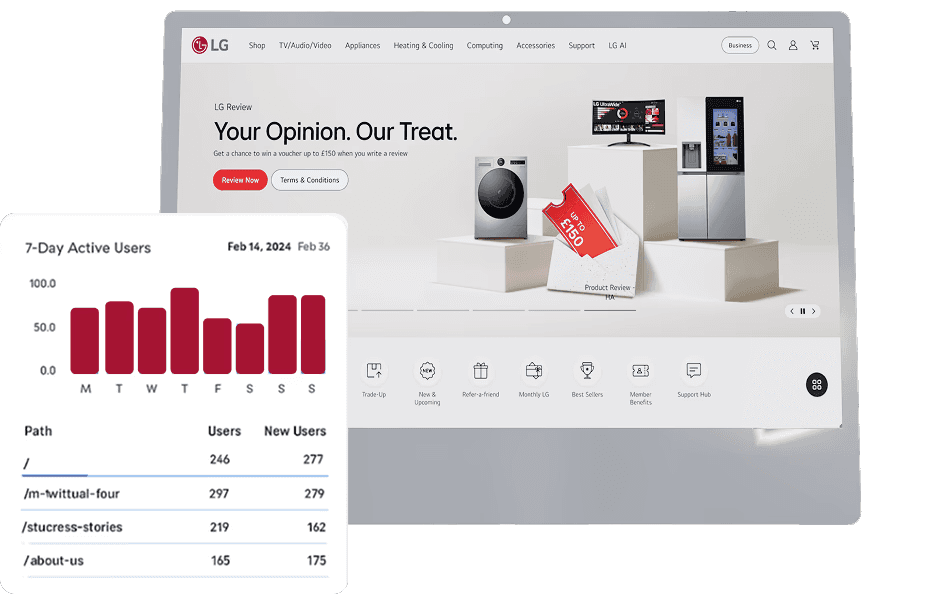
This project draws from my work on the 8-weeks LG CNS UI/UX team, where I analyzed user behavior across 36+ global e-commerce markets with a focus on the UK. By combining GA4 data, cultural insights, and benchmarking, I uncovered why certain globally successful products underperformed locally and how spatial constraints shaped user decisions. These findings informed the redesign of AI-personalized recommendations and up-sell modules, creating a more context-aware and market-relevant shopping experience.

This project draws from my work on the 8-weeks LG CNS UI/UX team, where I analyzed user behavior across 36+ global e-commerce markets with a focus on the UK. By combining GA4 data, cultural insights, and benchmarking, I uncovered why certain globally successful products underperformed locally and how spatial constraints shaped user decisions. These findings informed the redesign of AI-personalized recommendations and up-sell modules, creating a more context-aware and market-relevant shopping experience.


My Role

UX Researcher,

UI Designer

Collaborators

Independent project supported by UI/UX team members

Date

Jan 2025

- Feb 2025

Introduction
LG.com functions as a single global platform serving 36 markets, but performance patterns differ dramatically by region.
During my time on the UI/UX team, one insight kept surfacing: The UK site showed exceptionally high engagement, but disproportionately low purchase conversions.


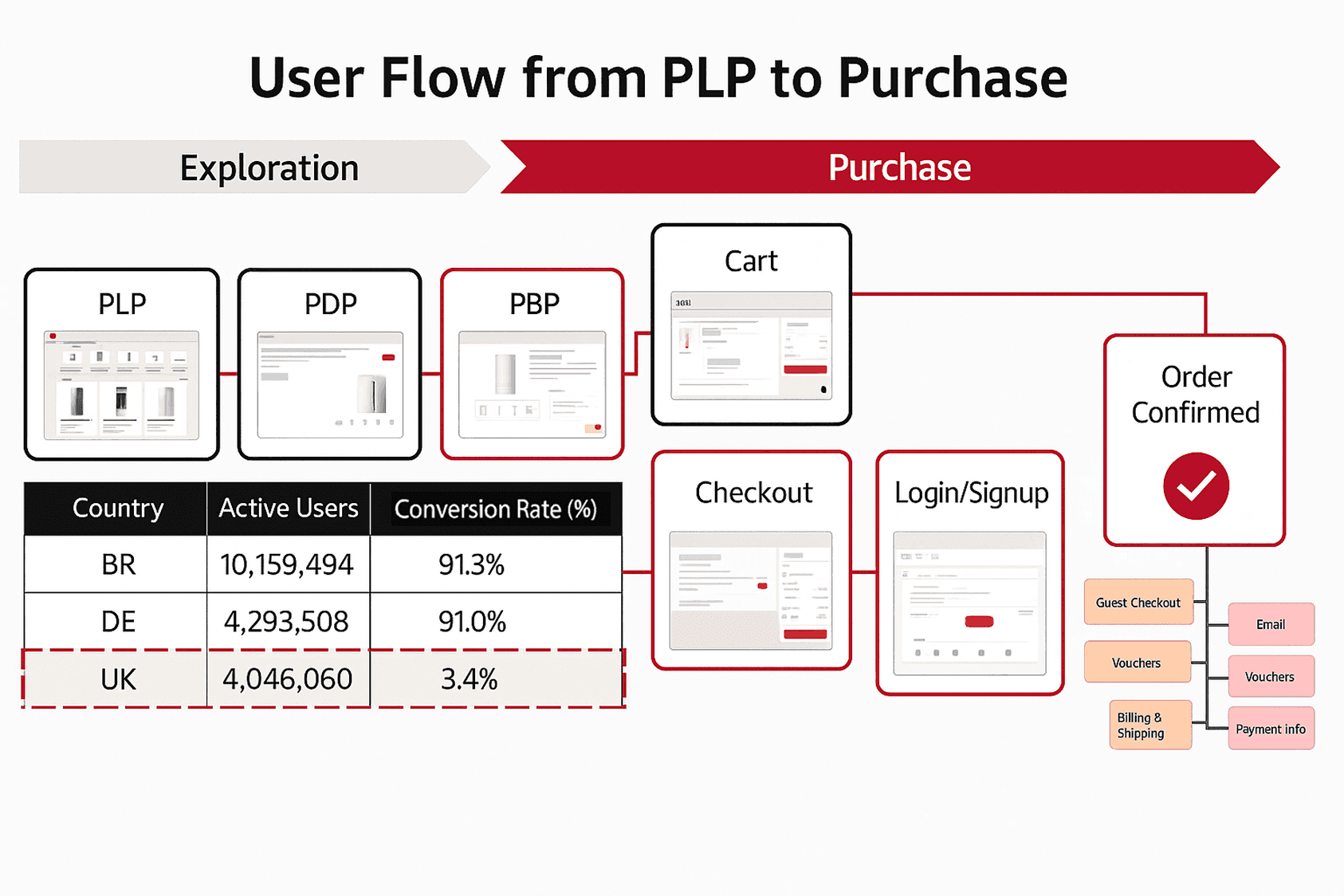
For instance, UK users displayed 96.6% page engagement, significantly higher than other regions. However, the purchase conversion lagged at 3.4%, far behind markets with similar traffic. This discrepancy signaled that the problem was not click-through or interest but rather a deeper behavioral or contextual disconnect between product presentation and UK users’ evaluation criteria. This became the core design challenge.


LG.com functions as a single global platform serving 36 markets, but performance patterns differ dramatically by region.


During my time on the UI/UX team, one insight kept surfacing: The UK site showed exceptionally high engagement, but disproportionately low purchase conversions.

For instance, UK users displayed 96.6% page engagement, significantly higher than other regions. However, the purchase conversion lagged at 3.4%, far behind markets with similar traffic. This discrepancy signaled that the problem was not click-through or interest but rather a deeper behavioral or contextual disconnect between product presentation and UK users’ evaluation criteria. This became the core design challenge.


When our team was first assigned to “build a kiosk for a campus space,” I asked a simple question: Where on campus do students feel the most overwhelmed and why?


Every teammate gave the same answer: Geisel Library. Geisel Library is one of the busiest spaces at UC San Diego where hundreds of students visit Geisel Library looking for a quiet space to focus or a room to meet with their team.

User Flow Map and Conversion Rate for Brazil, Germany, and UK


Research Methods

User Flow Map and Conversion Rate for Brazil, Germany, and UK

  1. Behavioral Data Analysis using Google Analytics

Re-organizing the mass data as funnels, I reviewed:

  • user flows from PLP → PDP → PBP → Cart → Checkout

  • device differences (mobile vs desktop), revealing major drop-offs

  • on-site interactions, scroll-depth, and add-to-basket intent signals

  • performance of modules such as “Frequently Bought Together” and “Our Picks for You”

From those data, I got an insight that users explored extensively, but hesitated at decision-making points.


  1. Cultural Comparative Research

Through comparative research on UK households and appliance usage patterns, I discovered that the UK homes are significantly smaller, especially kitchens and laundry spaces and that the UK consumers prioritize compactness, noise level, and energy efficiency. Moreover, it was evident that the large appliance photos and US/EU-standard product positioning did not resonate. This contextual gap helped explain why globally best-selling models performed poorly in the UK.


  1. Competitive Benchmarking

As our data revealed that UK users were highly engaged but hesitant at decision-making moments, I broadened the research to understand: How do other global e-commerce platforms help users move confidently from exploration to purchase?


Instead of starting with a predetermined solution, I reviewed Amazon, Walmart, and Samsung to analyze how they reduce cognitive load during product comparison, how they frame “better fit” decisions, how they present related items without overwhelming users, and how they build trust around high-consideration products.


It was conducted to understand how leading platforms support user confidence and identify what LG.com lacked in the UK context.

After unpacking behavioral patterns, I reframed the problem to be: UK users don’t need more products, but they need the right product presented in the right context, at the right moment.

  1. Behavioral Data Analysis using Google Analytics

Re-organizing the mass data as funnels, I reviewed:

  • user flows from PLP → PDP → PBP → Cart → Checkout

  • device differences (mobile vs desktop), revealing major drop-offs

  • on-site interactions, scroll-depth, and add-to-basket intent signals

  • performance of modules such as “Frequently Bought Together” and “Our Picks for You”


From those data, I got an insight that users explored extensively, but hesitated at decision-making points.


  1. Cultural Comparative Research

Through comparative research on UK households and appliance usage patterns, I discovered that the UK homes are significantly smaller, especially kitchens and laundry spaces and that the UK consumers prioritize compactness, noise level, and energy efficiency. Moreover, it was evident that the large appliance photos and US/EU-standard product positioning did not resonate. This contextual gap helped explain why globally best-selling models performed poorly in the UK.


  1. Competitive Benchmarking

As our data revealed that UK users were highly engaged but hesitant at decision-making moments, I broadened the research to understand: How do other global e-commerce platforms help users move confidently from exploration to purchase?


Instead of starting with a predetermined solution, I reviewed Amazon, Walmart, and Samsung to analyze how they reduce cognitive load during product comparison, how they frame “better fit” decisions, how they present related items without overwhelming users, and how they build trust around high-consideration products.


It was conducted to understand how leading platforms support user confidence and identify what LG.com lacked in the UK context.

After unpacking behavioral patterns, I reframed the problem to be: UK users don’t need more products, but they need the right product presented in the right context, at the right moment.


Design Solution

Based on these insights, I reframed the design direction:


  1. Localize the item display without breaking global consistency.

  1. Show why a product is the right fit — not just the newest or most expensive. (This strategy would ultimately increase revenue.)

  2. Highlight compact models, noise info, energy rating, and space-related attributes earlier.

  3. Redesign recommendation and comparison modules to build confidence.


To implement these design directions, I concluded that instead of optimizing a single UI module, the stronger solution was to develop an AI-driven personalization strategy that dynamically adjusts the entire user experience. AI enables the system to surface the right product at the right moment, personalized to each user’s needs and behavioral patterns. With the data analyst, we have segmented the UK users based on the following browsing behaviors:


  • priority signals (size, efficiency, noise)

  • device type

  • category preferences

  • home context patterns across UK users


Then, I designed the possible AI implementation UI to showcase models based on compactness, noise level, sustainability ratings, and common UK use cases.
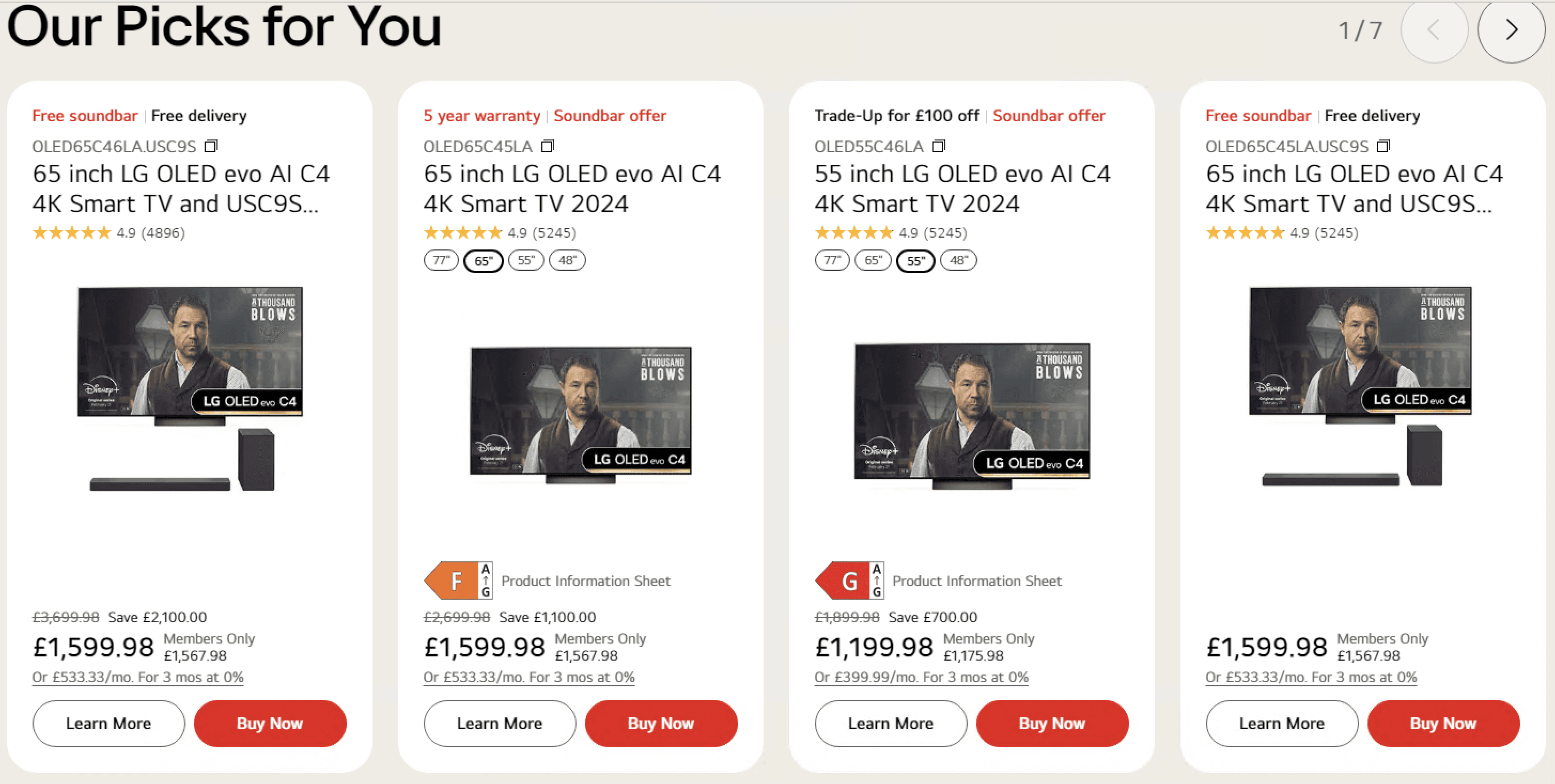
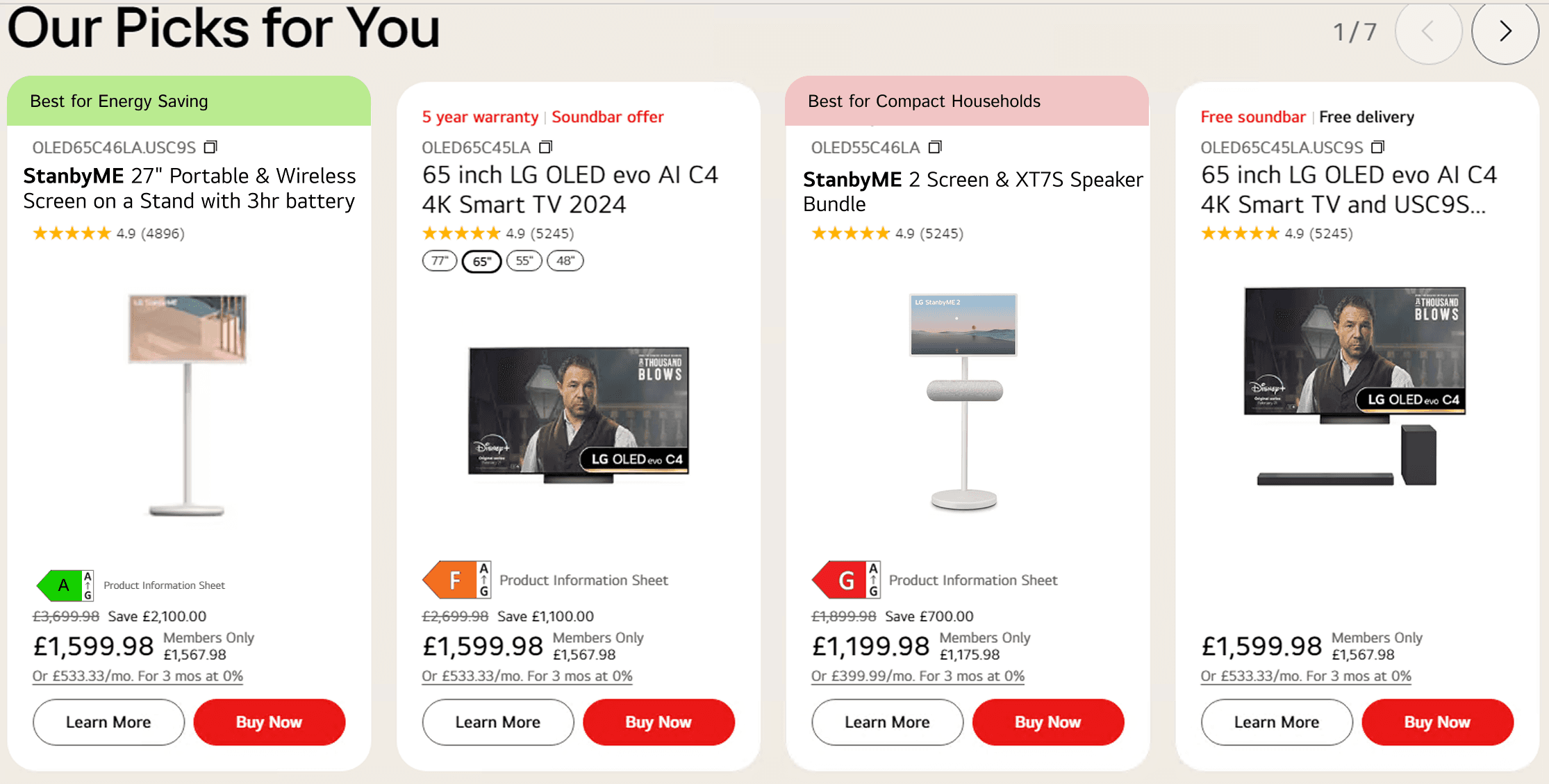
LG.com UK Recommendation Module: Original vs. AI-Personalized Redesign Prototype

In the redesign, I introduced AI-driven recommendations that surface smaller, space-efficient models and highlight energy-efficient products using intuitive color tags (green for energy efficiency, LG red for brand-aligned cues).

LG.com UK Recommendation Module:

Original vs. AI-Personalized Redesign Prototype

Although the feature could not be fully deployed due to timeline and system constraints, I designed the solution with a realistic AI architecture in mind. Each user’s interactions would feed into a lightweight machine-learning model that infers priorities such as preferred product size, energy efficiency, or feature sensitivity; and that would dynamically reorganizes the UI and content hierarchy. Over time, this system would become increasingly tailored, while still scaling across 36+ global markets and supporting market-specific behaviors like the UK’s preference for compact appliances.

What this project taught me


What this project taught me

This project reinforced that global e-commerce cannot rely on a single template—it must adapt to the cultural, spatial, and behavioral realities of each market. Designing an AI personalization framework pushed me to think beyond UI-level fixes and focus instead on system-level clarity, relevance, and decision confidence.


Key Takeaways

  • Context matters: UK users’ spatial constraints and browsing behaviors required a localized approach.

  • AI as strategy, not feature: personalization becomes meaningful only when grounded in real user priorities.

  • Design at scale: solutions must flex across 36+ global markets while preserving local nuance.

  • Zoom out → zoom in: strong design decisions come from understanding the ecosystem before shaping the interface.


If I were to continue this project, I would:

  • Deploy the personalization prototype and analyze changes in user behavior

  • Explore additional AI applications beyond “Our Picks for You” to support decision confidence across the full journey


As this project was completed at LG CNS, some details cannot be shared publicly. If additional context would be helpful, I’m happy to share more privately.


You can reach me at janetteylim@gmail.com.

© 2025 Janette Lim 🎨

© 2025 Janette Lim 🎨